Home Our Mission FAQ Resources About Us...
   Frequently Asked Questions

Choices:


How can I get a burn permit? What can I burn on my property?
You can get a burn permit from members of our department who are authorized agents of the Department of Natural Resources. Since we are not manned around the clock, it would be best if you call Call us at: (401) 568-5020(401-568-5020) a day or two before you want the permit.

Permits can only be given out the day you intend to use it.

IT'S THE LAW

The following is the law as enforced by the Department of Natural Resources:

A. Open Burning:

    Open burning of any type requires a written permit from the Director of the Department of Natural Resources or his authorized agent. In all instances fires must be attended until fully extinguished.

    Penalties for Violations:

  1. Fine of not less than $10.00 nor more than $100.00 or imprisonment for not more than 30 days nor less than 10 days, or both
  2. Liability for all damages and suppression costs in fighting a resulting fire.
B. Burning in rubbish burners, incinerators and outdoor fireplaces:
  1. Allowed without a written permit before 10:00 a.m. and after 5:00 p.m. from March 15th to May 15th.
  2. With a written permit between 10:00 a.m. and 5:00 p.m. unless rain is falling or snow covers the ground.
  3. In either or both instances fires must be attended until fully extinguished

    Penalties for Violations:

  1. Fine of not less than $10.00 nor more than $100.00 or imprisonment for not more than 30 days nor less than 10 days, or both
  2. Liability for all damages and suppression costs in fighting a resulting fire.
You can only burn brush. In other words, you can burn leaves, twigs, branches, sticks, pine needles, etc. You CANNOT burn anything else including building materials, tires, rubber, plastic, or anything other than brush.

back...


I want to protect my house, or I'm selling my house. What type of smoke detectors should I have?

Every house should have smoke and CO detectors in it already. The type of detector mandated for your home depends on the age of the house. See below for detector type and proper locations.

You need one detector per 1200 square feet. One detector per floor is usually sufficient.

Follow manufacturer's installation instructions. Generally, placement of detectors should be on the ceiling, at least 12 inches from any wall. If detectors must be installed on the wall, they should be between 6 inches and 12 inches down from the ceiling.

If you need an inspection, please call us (401-568-5020) at least TWO WEEKS before your closing. There will be a thirty dollar charge for the inspection. If paying by check, make check payable to the "Nasonville Fire Department".

Thank you.

IF your house was built:

  • Prior to June 1976:
    BATTERY OPERATED DETECTORS
    • You need smoke detectors and CO detectors in general area of sleeping quarters (within 10 feet).
    • You also need a smoke and CO detector on every habitable floor (a floor that you normally use) of your house. For example, if you have a full attic and it is used for anything other than storage, for example, a TV room or a bedroom, you need a detector.
    • If you have bedrooms off the kitchen, you need detectors in those rooms as well.
    • In the basement:
      • If you have open stairs (you can look through the stairs and see behind them) you need a detector at the top of the stairs.
      • If you cannot see through your stairs, you need one at the bottom of the stairs within 24 inches of the stairway.


  • Between July 1976 and January 1st, 1992:
    AC POWERED, INTERCONNECTED DETECTORS (When one goes off, they all go off)
    • You need smoke detectors and CO detectors in general area of sleeping quarters (within 10 feet).
    • You also need a smoke and CO detector on every habitable floor (a floor that you normally use) of your house. For example, if you have a full attic and it is used for anything other than storage, for example, a TV room or a bedroom, you need a detector.
    • If you have bedrooms off the kitchen, you need detectors in those rooms as well.
    • In the basement:
      • If you have open stairs (you can look through the stairs and see behind them) you need a detector at the top of the stairs.
      • If you cannot see through your stairs, you need one at the bottom of the stairs within 24 inches of the stairway.


  • January 1992 to present:
    AC POWERED, INTERCONNECTED (When one goes off, they all go off) DETECTORS WITH BATTERY BACKUP
    • You need smoke detectors and CO detectors in general area of sleeping quarters (within 10 feet).
    • You also need a smoke and CO detector on every habitable floor (a floor that you normally use) of your house. For example, if you have a full attic and it is used for anything other than storage, for example, a TV room or a bedroom, you need a detector.
    • If you have bedrooms off the kitchen, you need detectors in those rooms as well.
    • In the basement:
      • If you have open stairs (you can look through the stairs and see behind them) you need a detector at the top of the stairs.
      • If you cannot see through your stairs, you need one at the bottom of the stairs within 24 inches of the stairway.

back...

Why do I need carbon monoxide detectors?

The simple answer: It's the law.

Another reason to have carbon monoxide (CO) detectors is for the safety element. Carbon monoxide is a by-product of incomplete combustion most often seen in the home as the result of malfunctioning of faulty equipment like oil burners, gas burners (natural and propane), wood burning stoves or fireplaces. Carbon monoxide is an odorless and colorless poison that can hurt you slowly in low levels, cause permanent neurological problems in moderate levels and is usually lethal at higher levels.

When fossil fuel fires or burners malfunction and emit carbon monixide, CO poisoning can occur. CO poisoning can happen within a few minutes and is responsible for more deaths than any other single poison.

Symptoms of CO poisoning may vary, but when people are exposed to low levels, many people will experience mild nausea and a mild headache. Exposure to moderate levels will strengthen symptoms along with light headedness and other flu-like symptoms. Exposure to high levels may result in death or the risk of neurological disorders.

For more information visit the carbon monoxide poisoning site.

back...


I think it's great that you people volunteer, but if I have a real fire, will real firefighters show up?

First and foremost, all fire departments train their personnel to be professionals. Some get paid, some do it voluntarilly. The distinction is "paid" versus "volunteer", not "professional" versus "volunteer".

Fires burn just as hot in volunteer districts as they do in paid districts. The tactics and technques employed are the same regardless of the pay status. We, in Nasonville, are lucky to have some well trained, very brave, and dedicated people on our department. We have very good equipment, new engines and an ALS rescue that all serve us well.

Many of the classes we attend are from the State Fire Academy, where certified instructors conduct the sessions. Often, volunteers attend classes shoulder to shoulder with career firefighters.

In our department, everyone is encouraged to take certified training and many of our members are NFPA Firefighter Level I certified. Some are even NFPA Firefighter Level II certified. Our EMTs attend classes with medics from around the state. Some of our EMTs even attended medic training at Brown University, or classes with "LifeFlight" at the University of Massachusetts.

When we respond to your incident, professionals arrive!

back...


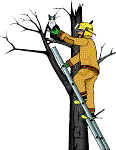
Do you really save cats in trees?

In a word, "yes".

We received a call once for a cat stuck in a tree. We had to set up one of our extension ladders to reach the cat. Our captain climbed the ladder, got the cat, placed it in his inverted helmet, and lowered it to the ground.

back...


How can I join the Nasonville Fire Department?

Volunteer Recruitment:
To join our department, simply fill out a membership form. You will be given an orientation of the policies and practices of the department. If you are over 18, you must also submit to a police background check. At the next scheduled monthly meeting your name will be submitted for the membership to vote for a 6 month probation period. Following a successful probation, your name is again brought to the floor of a monthly meeting and the membership votes you on the department with full voting member status.

Application Requirements:
Contact Information:
Fire Chief - Membership
2577 Victory Highway
Village of Nasonville
Burrillville, RI 02830
Phone: 568-5020

back...

© copyright 2003 | Nasonville Volunteer Fire Department | online since 1997 | all rights reserved